Wednesday, March 26, 2014

Economic Interactions and Flows

http://greenfieldgeography.wikispaces.com/Information+flows

Global Services Location Index (GSLI)


at-kearney-global-services-location-index-2011_650.jpg


 This index was established in 2004, the GSLI analyses and ranks the top 50 countries worldwide as the best destinations for providing outsourcing activities, including IT services and support, contact centers and back-office support. Each country’s score is composed of a weighted combination of relative scores on 43 measurements, which are grouped into three categories: financial attractiveness, people skills and availability, and business environment."

This article is most interesting to me, because I never heard about the existence of index which scores the global services on different countries. Also, I was surprised that the top 10 countries which have high scores are mostly developing countries. I can understand that many people of these countries are available for work since they have large population. But still, the conversion of business environment to numbers is extremely amazing.

Question: How does the financial attractiveness and business environment is converted to number? What is the base of analysis?

Tuesday, March 18, 2014

Loss of Sovereignty

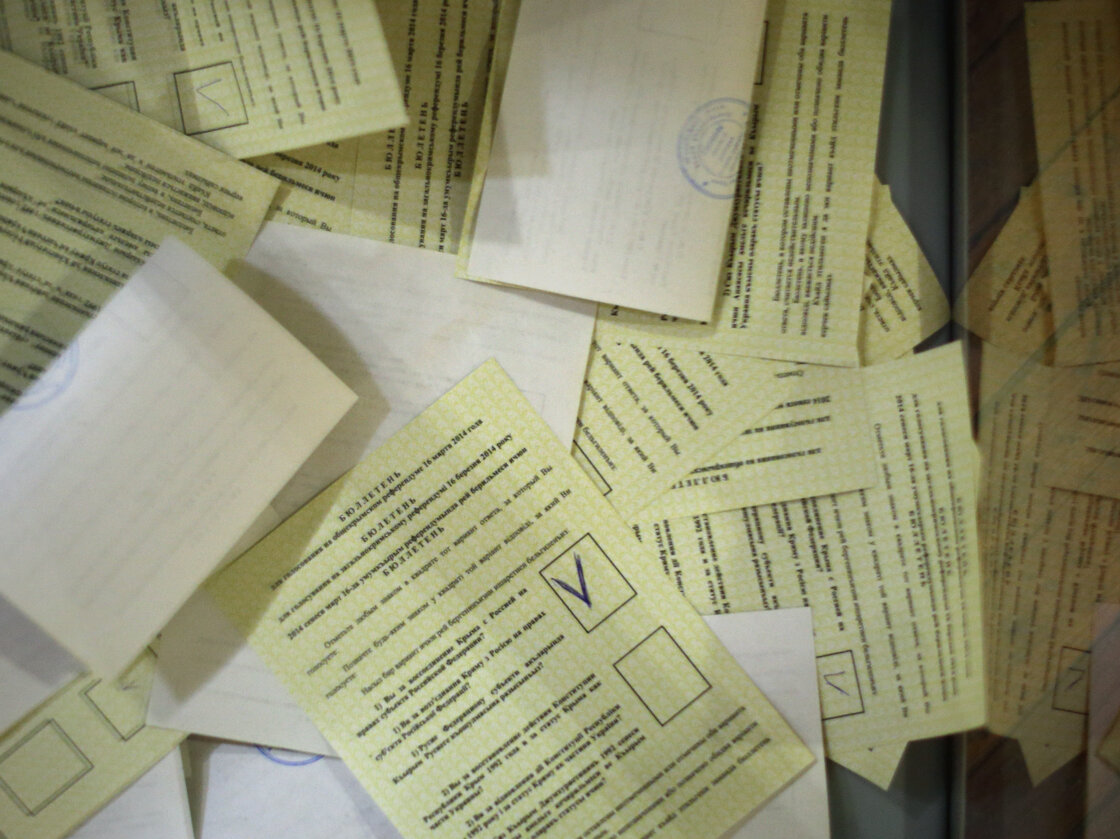
A pile of the votes cast Sunday in Simferopol, Ukraine, the regional capital of Crimea.
(A pile of votes cast sunday in Simferopol, Ukraine, the capital of Crimea)
<http://www.npr.org/blogs/thetwo-way/2014/03/17/290788338/u-s-and-eu-ready-sanctions-crimea-asks-to-join-russia>

Russia got 93% of votes from the people of Crimea where the people agreed Crimea to be part of Russia. However, U.S and E.U countries are not agreeing about the result of the votes. E.U countries and U.S is concerned that Russia is resulting on isolation from the rest of the world community.

In my opinion, I predict that Crimea would be part of Russia because majority of people in Crimea wants them to be part of Russia instead of Ukraine.  If Crimea would be still part of Ukraine, the people might suffer from discrimination. In fact, Russia promised the ultimate authorities for Crimea, where there is no discrimination. So for the people in Crimea, it's better for them to be part of Russia. However, this event could be a big spark for conflicts between Russia and other European countries because Russia would grow more influence to the eastern Europe.


Thursday, March 13, 2014

Cultural Diffusion

Cultural diffusion: the process:

We are living in a diverse society where every countries are 'globalized' where there is fusion of different cultures especially cuisine and dress. People tends to find more comfortable 'culture 'for them after globalization. For instance, people don't usually wear their traditional clothes, but mostly wear simple looks like T-shirts and jeans for the comfort. Also, most people tends to enjoy fast foods which is a delicious simple meal with complete nutrience. In fact, fast food stores like McDonald is became very famous where the world came to the state to count the number of McDonald chains to determine how globalized the country is.

People's cultural traits also changes through tourists and oversea workers. When tourists travel to different places, they tends to learn the different cultures, come back to their country, and spread the cultures where there is diffusion of different cultures. For instance, Republic of Korea and China has similar culinary cultures since there were many connections between these two countries. Not only tourists, but oversea workers also have roles to diffuse the cultures. Most of the oversea workers comes from LEDC to work for MEDC. So modified and developed cultures of MEDCs are often diffused to LEDCs.

Monday, March 10, 2014

Pros and Cons of globalization

Pros and Cons of globalization:

Pros:

Since globalization is the movement and integration of goods and people among different countries, there is increase in communication because the way of communication technology has developed, and wide spread. For instance, by using Skype, people can communicate each other easily wherever they are.

Globalization also makes products of company to decrease, to make the price affordable to people. For instance, Nike factory is transferred to Bangladesh to use cheap labor force which would be cost efficient. Same with T-shirt companies, where they locate the factories to the countries like Indonesia to make the price lower and affordable for their own country's people.

"Shrinks the world". Through globalization, people were able to afford various products from other countries. For instance, everybody in the world would have tasted grape from Chile which is seedless and sweet. So people don't have to travel other countries, but enjoy the products of other countries from their own country.

Globalization also helps the country to earn money in specific direction, and what to do to increase the economy. For instance, the peripheral countries like Brazil exports bunch of raw materials like beef and coffee beans to semi peripheral and core countries, and semi peripheral and core countries process the coffee beans through coffee and sell them. Therefore, in peripheral country, farming is mostly the major way to earn money, some of farming and service for semi peripheral country, and mostly service for core countries.

Cons:

Globalization can be start of neo colonialism if fair trade is not used. For instance, peripheral countries must sell their raw materials to the core countries earn money. Which means that the core country has absolute control over the peripheral country's economy. For instance, farmers in Brazil barely earns money even though they sell raw materials to the foreign company. So rich companies gets richer, and poor people gets poorer.

Also, since there is more exports and imports from neighborhood countries, private business such as banana sellers can be affected if there is massive import of banana from foreign country where the price of banana will get down.